
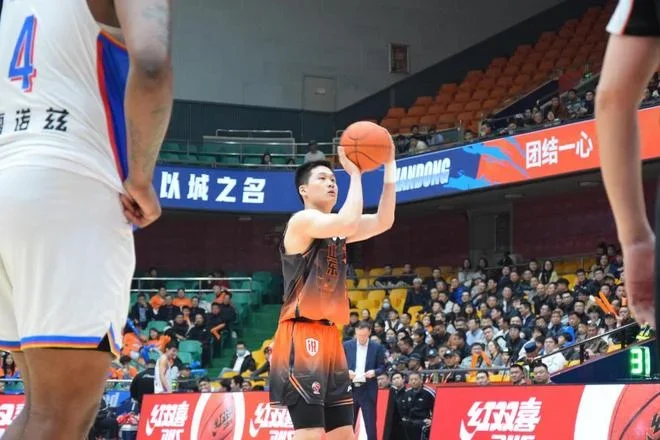
On the evening of May 9, the final buzzer of Game 2 in the CBA quarterfinals sounded, marking the end of the Shandong Hi-Speed men’s basketball team’s season. The team fell 68-96 at home to the Shanghai Sharks, swept 0-2 in the series. While the exit in the top eight was disappointing, what deserves deeper scrutiny is the team’s lack of progress in developing young talent this season.
Shandong, a province rich in basketball tradition, has produced numerous players for the CBA. However, the Hi-Speed team’s local rookie development has hit a red light, with a clear generational gap that needs urgent resolution.
At the start of the season, the club showed intention to foster young players. During the offseason, five youth team players—Chang Haoran, Ma Yandong, Wang Zheng, Xie Wenzheng, and Zhao Haoran—were promoted to the first team. Club management publicly stated that the new season would prioritize giving young players more opportunities to address the team’s local talent shortage. Expectations were high that the team, with its deep youth training roots, could inject fresh energy and build a foundation for long-term success.
Yet, as the season unfolded, the results of rookie development were underwhelming. Among the promoted players, only Wang Zheng, a 2007-born guard, stood out. He appeared in 21 regular-season games, averaging 8.9 minutes and 4 points per game. As a shooter, he showed solid accuracy and confidence on the court. In a home game against Ningbo, Wang hit three consecutive three-pointers in a short span, finishing with 11 points and proving his potential.
In contrast, the other rookies struggled for playing time, spending most games on the bench and failing to make an impact. This pattern of promoting without proper nurturing rendered the team’s promise of fresh blood hollow.
Compounding the issue, several Shandong-born players flourishing elsewhere highlighted the team’s developmental failures. He Xining, a native of Jinan, had a breakout season with the Shenzhen Leopards, earning the CBA regular-season MVP and a spot on the national team. Shandong never lacks basketball talent, but it lacks the patience and system to discover and cultivate it.
This season, the team’s rookie development problem remained unresolved: young players lacked game experience, limiting their growth and thinning the roster. To maintain competitive results, the coaching staff relied more on veterans and imports, further reducing opportunities for newcomers. This created a vicious cycle—less practice led to slower improvement, and slower improvement led to even fewer chances.
For the Hi-Speed men’s basketball team, developing local talent is not just about long-term success but also about carrying the torch for Shandong basketball. With veteran Tao Hanlin’s contract nearing its end and a looming shortage of interior players, the need for effective rookie development has never been more urgent. Only by confronting this challenge and bridging the generational gap can the team honor the province’s proud basketball legacy.